Light counts and shadow choices are among the biggest scene-level performance levers in UE5 - and among the easiest to audit.
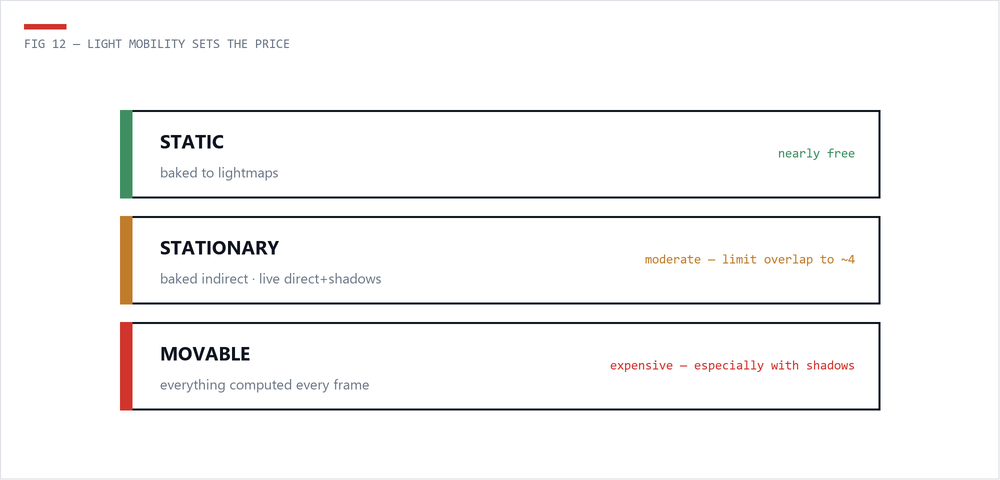
Static lights bake to lightmaps (nearly free at runtime); Stationary lights bake indirect but compute direct lighting and shadows live (limit ~4 overlapping); Movable lights compute everything every frame. The audit rule mirrors meshes: nothing should be Movable that doesn't need to be.
A movable point light casting shadows re-renders its surroundings into a shadow map - a point light does it in six directions. From the master checklist: keep light counts low, especially shadowed movable lights - one of the biggest scene-level wins. The audit passes:
Lumen delivers dynamic global illumination and reflections for a per-frame GPU cost driven by quality settings, screen percentage, and scene complexity (check stat gpu -> Lumen passes). The high-level levers: Global Illumination and Reflection quality scalability groups, Software vs Hardware Ray Tracing choice, and Surface Cache health - materials must be Surface-Cache-friendly (visualize with Lumen view modes). On tight budgets, baked lighting remains a legitimate, gorgeous, nearly-free option for static scenes.
VSM (the UE5 default) delivers crisp shadows but its cost scales with light count, resolution, and - critically - invalidations: anything moving (or animating via WPO) forces shadow pages to re-render. Keep WPO off distant things, keep movable objects minimal, and watch the VSM stats when shadows dominate stat gpu.
Volumetric fog on every light adds up - enable per-light volumetric contribution deliberately. Light functions are per-pixel material evaluations. IES profiles are cheap; light channels are organizational, not free. And the sun: one directional light, cascades tuned to gameplay distances, not defaults.
 The Technical Artist