Why Soft Skills Matter
Technical art is fundamentally a people discipline disguised as a technical one. Your shaders, tools, and pipelines exist for one reason: to make other people more productive. TAs sit at one of the most complex intersections in game development -- translating every day between people who think in visual terms ("I want this to feel warm and cinematic") and people who think in technical terms ("We need to keep draw calls under 2000 and maintain 60fps"). This translation requires understanding the priorities, constraints, and mental models of each discipline. Your success is measured by other people's productivity, which means empathy is a technical requirement. A TA with strong communication skills but moderate technical ability will consistently outperform a technically brilliant TA who cannot explain their work, because tools designed from conversations with users solve the right problems, clear documentation drives fast adoption, and feedback loops keep tools improving.
Communication and Translation
The most essential TA communication skill is bidirectional translation between art and engineering. When an artist says "it looks flat," you need to hear "needs better normal mapping, AO, or lighting contrast." When an engineer says "we are draw call bound," you need to translate that for artists as "we need to combine some materials and use atlases." Beyond translation, writing clear technical documentation is one of the highest-leverage activities a TA can do -- every hour spent writing clear docs saves dozens of hours of one-on-one explanations. Active listening is equally critical: paraphrasing back what you hear, asking clarifying questions, observing how people actually work, and looking for the underlying need behind a request. When giving feedback, be specific and focus on the work rather than the person; when receiving feedback, resist defensiveness and act on it visibly. Running productive meetings means sending a clear agenda beforehand, time-boxing discussions, ending with action items, and following up within 24 hours.
Time Management and Prioritization
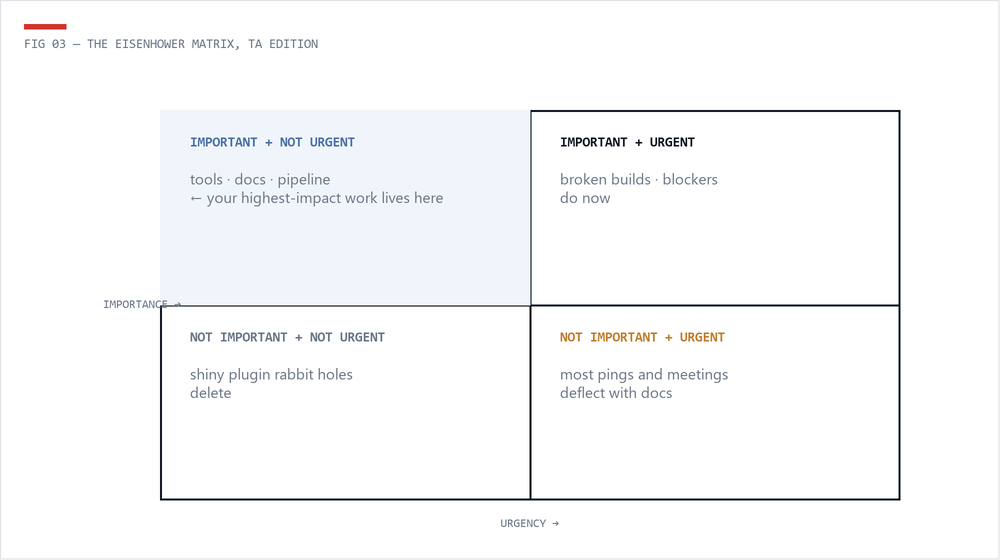
Technical artists face a unique time management challenge: they are simultaneously reactive (putting out fires, fixing broken builds, answering questions) and proactive (building tools, improving pipelines, writing documentation). Without deliberate management, proactive work never gets done. The Eisenhower Matrix helps: most of your highest-impact work lives in the "Important but Not Urgent" quadrant -- tool development, documentation, pipeline improvements -- but most of your day gets consumed by urgent requests. Strategies for protecting proactive time include time blocking (reserving 2-3 hour blocks for deep work), setting office hours for support questions, applying the 15-minute rule (handle quick requests immediately, schedule longer ones), treating automation as investment, and using documentation as deflection. Context switching is enormously expensive -- a 5-minute interruption can cost 20 minutes total when you factor in rebuilding your mental model. Batch similar work, keep notes on your mental state before switching tasks, and communicate your focus time clearly to colleagues.
Career Development and Leadership
As TAs grow in seniority, their impact increasingly comes through others. The career path typically progresses from Junior (executing tasks under guidance) through Mid-Level (owning features independently) to Senior (driving technical direction and mentoring). At the senior level, the path diverges: the Individual Contributor track leads to Principal TA with deep expertise and industry recognition, while the Management track leads to Lead TA and Director roles focused on team leadership, strategy, and hiring. Key leadership skills include running effective one-on-ones, setting measurable goals aligned with team objectives, delivering performance reviews without surprises, and mentoring junior TAs through pairing sessions, stretch assignments, and code reviews that teach principles. Emotional intelligence underpins all of this -- recognizing your own triggers, pausing before reacting, reframing criticism as opportunity, and reading the room during meetings. Whether you choose the IC or management track, the constant is that soft skills are not secondary skills; they are the primary mechanism through which technical skills create impact.